Specialist Disability Accommodation (SDA) is NDIS funding for the capital cost of a purpose-built home, not for the day-to-day support delivered inside it. It’s designed for participants with an extreme functional impairment or very high support needs, where purpose-built or modified housing genuinely reduces reliance on person-to-person care or makes that support far more efficient to deliver. Once eligibility is established, the next question is almost always practical: how much does SDA actually cost, who pays for what, and how does funding work in practice?
This guide breaks down the full picture using the NDIS Pricing Arrangements for Specialist Disability Accommodation 2026–27, effective from 1 July 2026. By the end, you’ll understand exactly how SDA is priced, what participants contribute out of pocket, and the practical steps to secure the right home.
What Is SDA Funding?
SDA funding is a dedicated category of NDIS support that covers the capital cost of physical housing.
SDA is included in the plans of participants who meet strict eligibility requirements: an extreme functional impairment or very high support needs where purpose-built or modified housing materially reduces the need for person-to-person care or makes that support significantly more efficient to deliver.
The National Disability Insurance Agency (NDIA) sets standard annual base price limits through its official SDA pricing arrangements to give providers, participants, and support coordinators a clear benchmark for reasonable housing costs.
How Are SDA Pricing Arrangements Set?
Rather than applying a single flat figure, SDA pricing arrangements calculate values using several property and service variables:
- Building Type: Apartments, villas/duplexes/townhouses, houses, or group homes.
- Occupancy & Shared Living: The number of bedrooms and SDA-eligible residents sharing the home.
- Design Category: The specific accessibility and specialist features built into the property.
- Location Factors: Regional adjustments benchmarked against capital cities to account for local land and construction costs.
- Fire Sprinklers: Whether an automated sprinkler system is installed, which impacts construction overheads.
- On-site Overnight Assistance (OOA): Whether dedicated space for overnight support staff is provided.
- GST Treatment: How GST was claimed when the property was built.
Each variable is applied to a base price and adjusted with a location factor.
For example: a highly accessible property in inner Sydney carries higher construction and land costs than a similar property in regional Queensland, and the pricing structure reflects these local market realities.
What Are the SDA Funding Levels?
Under the 2026–27 pricing arrangements, the maximum annual base price per participant varies based on dwelling size, building type, and design category.
Sample Base Price Comparison (Post-2023 New Builds, GST Claimed, No Sprinklers)
| Building & Occupancy Type | Improved Liveability | Fully Accessible | Robust | High Physical Support |
| 4-Bedroom Group Home (4 Residents, No OOA) | ~$39,310 | ~$40,789 | ~$44,336 | ~$47,689 |
| 1-Bedroom Apartment (1 Resident, No OOA) | $81,414 | $83,954 | N/A | $91,248 |
| 1-Bedroom Apartment (1 Resident, With OOA) | ~$94,983 | ~$97,523 | N/A | ~$104,817 |
Smaller dwellings with single-occupancy arrangements attract higher per-participant prices because fixed property costs are not shared across multiple residents. On-site overnight assistance, location factors, and sprinkler installations further adjust these baseline figures.
How Much Do Participants Contribute? (SDA Participant Contribution)
While NDIS SDA funding covers property capital costs, participants make an out-of-pocket SDA participant contribution toward rent and daily board (usually funded via the Disability Support Pension or personal income).
SDA Participant Contribution
| Maximum Reasonable Rent Contribution (MRRC): 25% of the basic Disability Support Pension + 100% of Commonwealth Rent Assistance Maximum Board Amount: Covers communal food, energy & day-to-day household operational expenses | Maximum Board AmountCovers communal food, energy & day-to-day household operational expenses |
1. Maximum Reasonable Rent Contribution (MRRC)
The standard MRRC cap ensures that housing remains affordable. It equals 25% of the basic Disability Support Pension plus 100% of Commonwealth Rent Assistance (CRA).
Fortnightly Maximum RRC Rates (20 March 2026 – 19 September 2026):
- Single participant: $516.11 per fortnight.
- Member of a couple: $327.05 per fortnight (each).
2. Board Contribution
When board is provided (covering communal groceries, utilities, and daily household items), recommended board caps apply:
- Single participant: $564.25 per fortnight.
- Member of a couple: $425.30 per fortnight (each).
Note: Rent and board caps are updated twice yearly in line with Department of Social Services indexing to the Disability Support Pension.
What Determines the Cost of a Specific SDA Property?
Two properties built under the same design category can have different final price structures due to two main factors:
1. Location Factors
Location multipliers benchmarked against capital cities adjust base prices. High-value metro areas (such as Sydney’s City and Inner South) carry location factors significantly above 1.00. Regional or outer-metropolitan zones often sit below 1.00, lowering the applicable maximum base price relative to metro benchmarks.
2. Shared & Mixed Occupancy
When SDA participants share a bedroom, pricing drops to roughly half the single-occupancy rate per person (less a portion of the rent contribution). If an SDA resident shares a dwelling with non-SDA residents, funding is calculated based on what the property would cost if scaled to the actual number of SDA-eligible bedrooms being used.
How to Apply for SDA Funding: Step-by-Step
Securing SDA funding requires clear, objective evidence demonstrating that specialist housing is necessary for your functional needs.
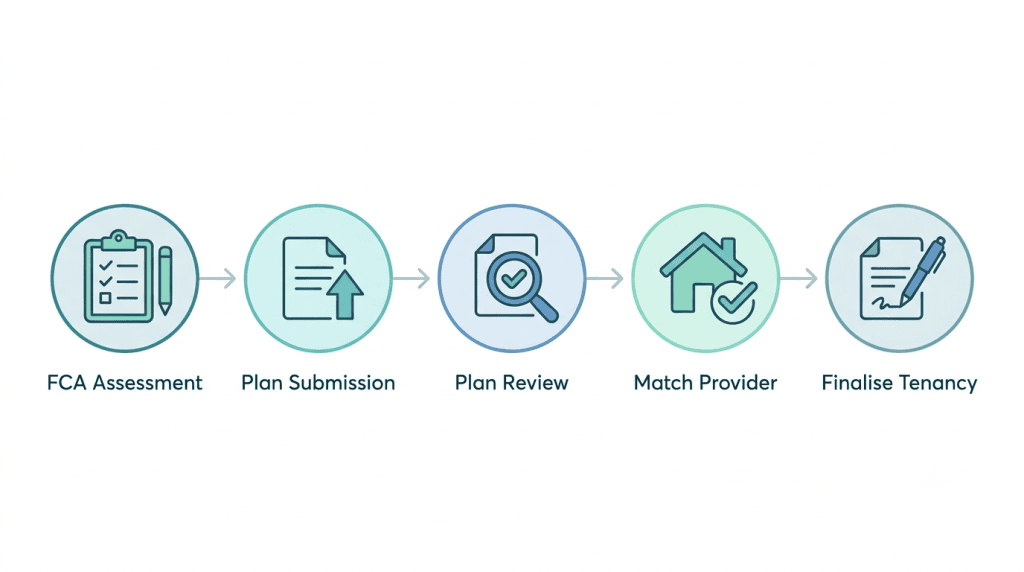
STEP 1: Functional Capacity Assessment
Secure a detailed Functional Capacity Assessment (FCA) from an Occupational Therapist (OT) documenting your extreme functional impairment or very high support needs.
STEP 2: Plan Inclusion & Evidence Submission
Work with your Support Coordinator to complete and submit the official Home and Living supporting documentation to the NDIA.
Before you get to this point, it’s worth making sure you actually meet the criteria and understand who qualifies for SDA funding under the NDIS.
STEP 3: Plan Review & NDIA Decision
Include SDA as an explicit funding request during your NDIS plan review or planning conversation.
STEP 4: Match & Secure an Enrolled Dwelling
Once approved, partner with a Registered SDA Provider and search for an enrolled SDA home that matches your funded design category, location, and building type.
STEP 5: Finalise Tenancy & Budget
Review and confirm the Reasonable Rent Contribution (RRC) and any board terms with your provider before signing your tenancy agreement.
Getting the Right Support Around Your SDA Journey
Navigating SDA pricing, location factors, participant contributions, and clinical evidence can feel overwhelming when done alone.
At Love Home Nursing, our experienced clinical team assists participants and families across every step of their journey. From gathering OT evidence to coordinating complex nursing care within specialist accommodation, we help ensure your housing and daily support needs work seamlessly together.
Ready to take the next step? You can easily make an NDIS referral or begin your intake today. If you’d like to chat through your options first, feel free to contact our team directly; we’re always here to discuss your disability support and complex nursing care needs.
FAQ
How much does SDA cost and who funds it?
SDA funding covers the capital cost of the housing itself, paid by the NDIS based on building type, design category, and location. Participants separately pay a rent and board contribution out of pocket, capped at 25% of the basic Disability Support Pension plus Commonwealth Rent Assistance, updated twice yearly.
Does SDA funding cover ongoing support costs like personal care?
No. SDA only covers the physical housing. Support costs such as personal care and daily assistance are funded separately through SIL or other supports in a participant’s NDIS plan.
Are SDA participant contributions the same for everyone?
No. The rent and board contribution amounts differ for a single participant versus a member of a couple, and both are recalculated twice a year based on Disability Support Pension indexing.