
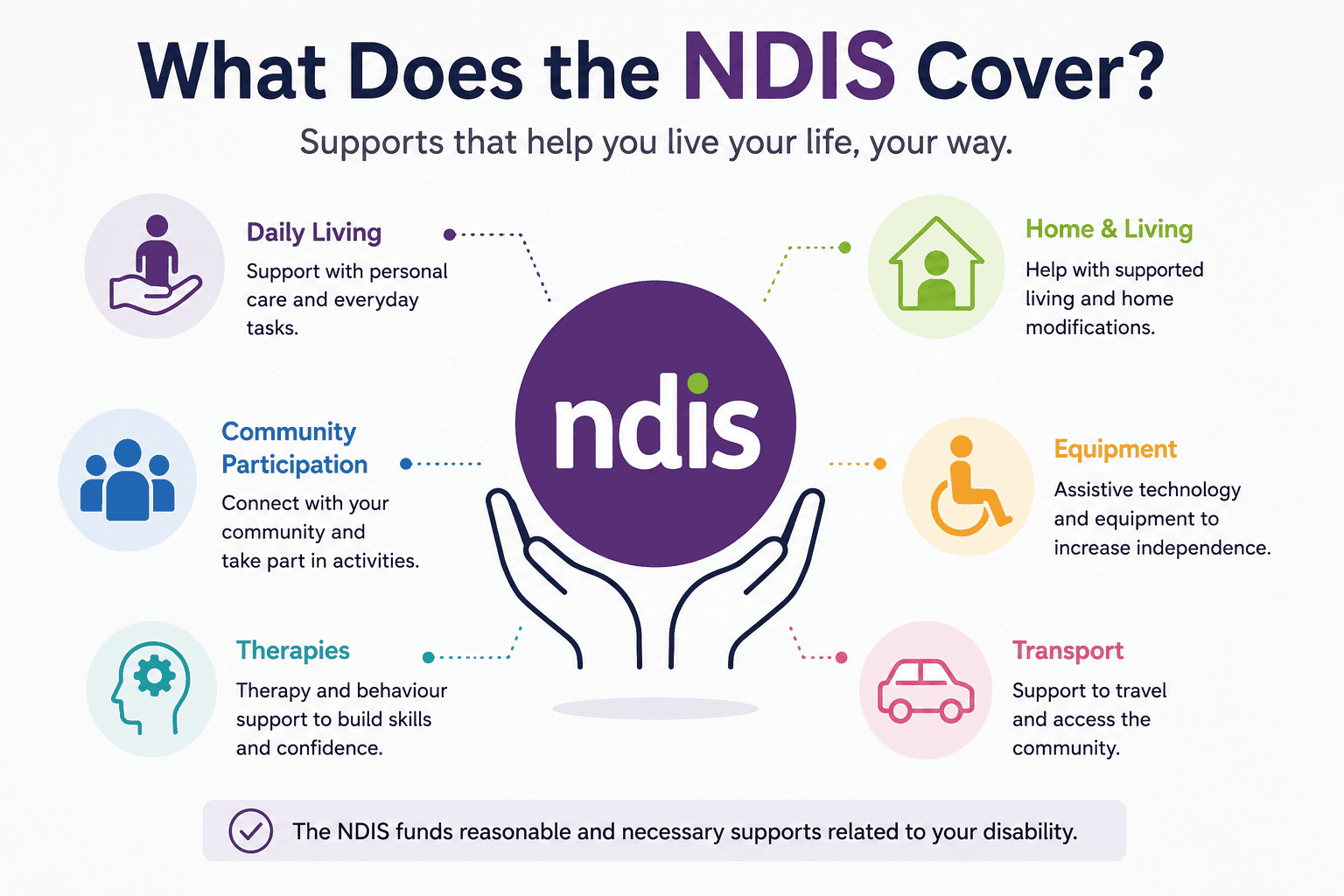
What Does the NDIS Cover?
If you’re new to the National Disability Insurance Scheme (NDIS), one of the first questions you may have is, “What does the NDIS actually cover?”
The answer depends on your individual goals, support needs, and NDIS plan. The NDIS funds a wide range of disability-related supports that help participants live more independently, build skills, access their community, and improve their quality of life.
This guide explains what the NDIS covers, what it doesn’t, and how funding decisions are made, using simple language that is easy to understand.
Quick Summary
| Question | Answer |
| Does the NDIS pay for disability supports? | Yes, if they are considered reasonable and necessary. |
| Does the NDIS pay rent or everyday living costs? | Generally, no. |
| Does the NDIS fund support workers? | Yes, where approved in your plan. |
| Does the NDIS cover therapy? | Yes, if it relates to your disability goals. |
| Does the NDIS pay for home modifications? | In many cases, yes. |
| Does the NDIS fund assistive technology? | Yes, when approved as reasonable and necessary. |
| Does everyone receive the same supports? | No. Every plan is tailored to the participant. |
What Does the NDIS Cover?
The NDIS funds reasonable and necessary supports that help eligible participants achieve their goals and increase independence.
These supports are grouped into three main funding categories:
- Core Supports
- Capital Supports
- Capacity Building Supports
The exact supports included depend on your individual circumstances and approved NDIS plan.
1. Core Supports
Core Supports help participants with everyday activities.
They are often the most commonly used part of an NDIS plan.
Examples include:
- Personal care
- Assistance with daily living
- Community participation
- Household tasks
- Transport supports
- Consumables
- Support workers
- Meal preparation assistance
- Social and recreational activities
Core Supports are generally designed to help participants manage everyday life safely and independently.
2. Capital Supports
Capital Supports fund larger purchases and one-off investments.
These may include:
- Wheelchairs
- Mobility equipment
- Communication devices
- Assistive technology
- Home modifications
- Vehicle modifications
- Specialist Disability Accommodation (SDA), where eligible
These items usually require assessment and approval before funding is provided.
3. Capacity Building Supports
Capacity Building Supports help participants develop skills and increase independence over time.
Examples include:
- Occupational therapy
- Physiotherapy
- Speech therapy
- Psychology
- Employment support
- Support coordination
- Life skills training
- Behaviour support
- Improved relationships
- Improved health and wellbeing
The goal is to help participants become more independent and achieve their personal goals.
How Does the NDIS Decide What to Fund?
The NDIS considers whether a support is reasonable and necessary.
Generally, a support should:
- Relate to your disability
- Help you pursue your goals
- Represent value for money
- Be effective and evidence-based
- Improve independence or participation
- Be safe and appropriate
- Not duplicate services funded by another government system
You can learn more about the funding criteria on the NDIS website .
What the NDIS Commonly Covers
Depending on your plan, the NDIS may fund:
Daily Living
- Personal care
- Showering
- Dressing
- Meal preparation
- Household assistance
Therapy Services
- Occupational therapy
- Physiotherapy
- Speech pathology
- Psychology
- Behaviour support
Community Participation
- Social activities
- Group programs
- Recreational support
- Community access
Assistive Technology
- Mobility aids
- Communication devices
- Hearing equipment
- Vision supports
Home and Living Supports
- Supported Independent Living (SIL)
- Specialist Disability Accommodation (SDA)
- Medium Term Accommodation (MTA)
- Individualised Living Options (ILO)
Transport
- Transport funding for eligible participants
- Community transport support
Employment Supports
- School leaver employment supports
- Employment-related assessments
- Workplace assistance
What the NDIS Does Not Usually Cover
The NDIS generally does not fund everyday living expenses that everyone is expected to pay.
Examples include:
- Rent
- Mortgage repayments
- Groceries
- Electricity bills
- Water bills
- Internet services
- General medical treatment
- Hospital care
- Medicare-funded services
- School fees
- Childcare
- Holiday expenses unrelated to disability supports
Other government systems may provide support for these costs.
Can the NDIS Pay for Housing?
This is a common question.
The NDIS generally does not pay for rent or purchasing a home.
However, it may fund disability-related housing supports such as:
- Supported Independent Living (SIL)
- Specialist Disability Accommodation (SDA)
- Home modifications
- Assistive technology used within the home
Each support has different eligibility requirements.
Tips for Getting the Most from Your NDIS Plan
To make the best use of your funding:
- Understand each funding category
- Keep receipts and records where required
- Work with your support coordinator or plan manager
- Review your goals regularly
- Use registered or suitable providers where appropriate
- Ask questions if you’re unsure about funding
Understanding your plan can help you make informed decisions throughout the year.
If you’re exploring housing supports, you may also find our guide on Understanding Supported Independent Living (SIL) in Geelong helpful.
Common Misconceptions About NDIS Funding
“The NDIS pays for everything.”
No. Funding is limited to supports that meet the reasonable and necessary criteria.
“Everyone receives the same funding.”
No. Every participant has different goals and support needs.
“I can spend my funding however I want.”
Funding must be used for approved supports within your NDIS plan.
“The NDIS covers all housing costs.”
No. The NDIS generally funds disability-related supports rather than everyday housing expenses.
Key Takeaways
- The NDIS funds disability-related supports that are reasonable and necessary.
- Funding is divided into Core Supports, Capital Supports, and Capacity Building Supports.
- Every participant’s plan is unique.
- Everyday living expenses are generally not funded.
- Understanding your funding categories helps you make informed decisions throughout your plan.
Final Thoughts
Understanding what the NDIS covers can make it easier to navigate your plan and access the supports that are most relevant to your needs. While every participant’s funding is different, knowing the three main funding categories and the principles behind reasonable and necessary supports can help you make informed decisions and prepare for plan discussions with greater confidence.
Frequently Asked Questions
1. What does the NDIS usually pay for?
The NDIS may fund support workers, therapy services, assistive technology, home modifications, transport, community participation, and disability-related housing supports when they are approved as reasonable and necessary.
2. Does the NDIS cover rent?
No. The NDIS does not usually pay rent or mortgage costs. However, it may fund disability-related supports such as Supported Independent Living (SIL) or Specialist Disability Accommodation (SDA) for eligible participants.
3. Does the NDIS pay for support workers?
No. The NDIS does not usually pay rent or mortgage costs. However, it may fund disability-related supports such as Supported Independent Living (SIL) or Specialist Disability Accommodation (SDA) for eligible participants.
4. Can the NDIS fund therapy services?
Yes. Therapy services such as occupational therapy, physiotherapy, speech pathology, psychology, and behaviour support may be funded if they relate to your disability goals.
5. How do I know if a support will be funded by the NDIS?
The NDIS assesses whether a support is reasonable and necessary, relates to your disability, helps you achieve your goals, provides value for money, and is not more appropriately funded by another government service.